


An interview with Mr. Jommy Mathew on monsoon and after monsoon management in pepper plantations, an experienced farmer with extensive cultivation experience.
Pepper cultivation requires careful management during the monsoon and the months that follow. Irrigation, nutrition, mulching, weed management and root-zone protection all play an important role in maintaining healthy pepper vines and supporting good yield.
In this interview, Mr. Jommy Mathew, an experienced pepper farmer from Karnataka, shares his practical experience and the management practices he follows in his pepper plantation.
Irrigation After the Monsoon;
According to Mr. Mathew, irrigation should be started soon after the rains stop, usually about 10 days after the end of the rainy period, depending on the conditions in the plantation.
He explains that when there are prolonged sunny periods after the rains, as experienced in some years, timely irrigation can help the vines recover from stress and support berry development.
Irrigation is particularly important during December and January, when the pepper berries are developing. After January, as the berries mature and harvesting approaches, irrigation can gradually be reduced.
“After January, the pepper berries start maturing, so irrigation should be reduced,” he explains.
By February, pepper generally reaches the harvesting stage, although the timing varies from one variety to another. After harvesting, some irrigation can be continued for about a month, but the vines should not be subjected to severe water stress.
Mr. Mathew says that irrigation may be continued according to the crop’s requirement until March or April.
Irrigation During Pre-Monsoon Rain:
Pre-monsoon rainfall requires particular attention. When scattered pre-monsoon showers begin, he recommends maintaining irrigation so that the vines receive relatively uniform moisture.
According to his observation, if irrigation is stopped too early during this period, flowering may be delayed and flowering may not occur uniformly. Continued irrigation during this transition period can help support more uniform flower-bud development.
Once continuous rainfall begins, however, irrigation should be stopped because the plantation is receiving sufficient natural moisture.
Drip Irrigation or Micro-Sprinkler?
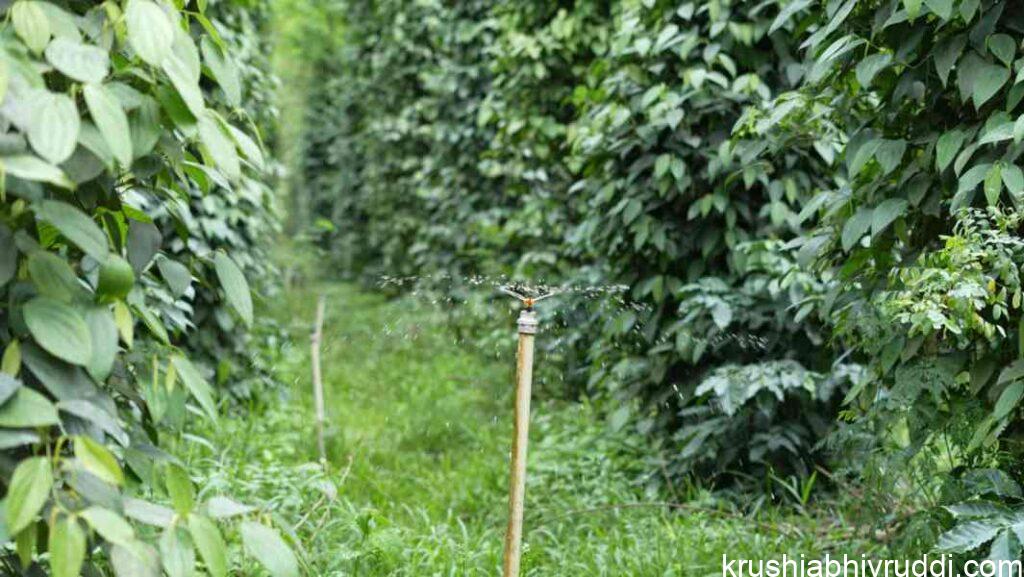
Mr. Mathew uses both drip and micro-sprinkler irrigation depending on the situation.
A micro-sprinkler distributes water over a wider area, similar to rainfall, whereas drip irrigation delivers water more directly to the required area around the vine.
In his practice, two drippers per vine can be sufficient, depending on the irrigation system and water requirement.
He also observes that uniform irrigation can contribute to more uniform flowering.
Both systems have advantages. However, micro-sprinklers can wet a larger area and may encourage more weed growth, whereas drip irrigation generally wets a more limited area and therefore may result in less weed growth around the vines.
The appropriate irrigation method should be selected according to water availability, soil conditions, plantation design and crop requirement.
Protecting the Root Zone:
According to Mr. Mathew, protecting the root zone is one of the most important aspects of pepper cultivation.
Unlike trees with a typical taproot, pepper has a predominantly fibrous root system. Therefore, maintaining good soil conditions around the root zone is important.
He regularly uses organic manure and leaf mulch around the vines. Mulching protects the soil surface, helps maintain suitable moisture conditions and reduces the direct impact of heavy raindrops on the soil.
Organic matter also helps maintain a loose soil structure and supports drainage. During periods of heavy rainfall, good drainage is essential because excess water should move away rather than remain around the roots.
Manuring and Fertilization:
Mr. Mathew follows a regular manuring and fertilization schedule based on his experience.
He usually begins with well-powdered sheep manure in May, applying approximately 1 kg per vine. Depending on rainfall and field conditions, he may also apply dolomite during May.
In June, he applies the first dose of chemical fertilizer, using approximately 200–250 grams of NPK per vine.
During July, when there is heavy rainfall, he applies about 1 kg of poultry manure away from the base of the vine.
At the end of August, he applies the second dose of NPK, again at around 200–250 grams per vine.
During September and October, he again applies powdered sheep manure and also uses microbial consortia as part of his organic management practice.
According to his current practice, after applying the microbial consortia, he does not apply additional chemical fertilizers or plant-protection products.
Mr. Mathew says that he has been following this particular manure-management practice for the past one or two years.
These quantities and timings represent Mr. Mathew’s own farm practice and should not be considered a universal fertilizer recommendation. Nutrient requirements can vary according to soil condition, variety, vine age, yield level and local recommendations.
Importance of Mulching:
Mr. Mathew places considerable importance on mulching.
At the beginning of the rainy season, dry leaves and other suitable organic material can be placed around the vines as mulch.
In his plantation, he has planted pepper along with silver oak and subabul trees. He explains that topping these trees before the monsoon provides a considerable quantity of organic material, which can be used as mulch for the pepper vines.
Similarly, when pepper is grown along with coffee, fallen coffee leaves naturally form a layer of mulch.
The mulch helps protect the soil surface, keeps the soil cooler and reduces the direct impact of raindrops on exposed soil.
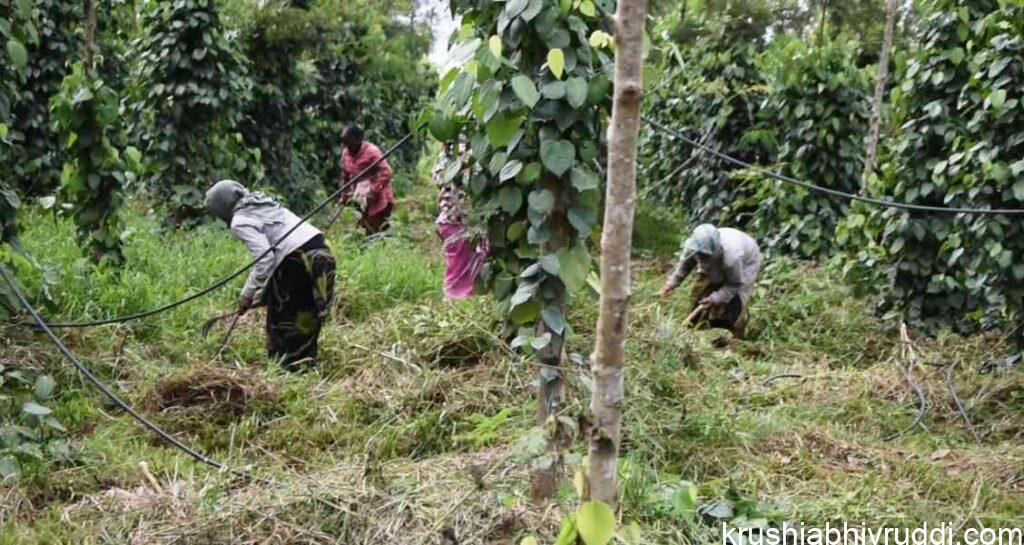
Mr. Mathew also recommends reusing suitable organic material collected during weed removal as mulch rather than wasting it.
Weed Management in Pepper Plantations:
Weed management is another important aspect of pepper cultivation.
Mr. Mathew says that the area immediately around the base of the pepper vines should be kept clean. During the monsoon, however, it may not always be necessary to remove every weed from the entire plantation.
Weed growth is generally higher at the beginning of the monsoon. At this stage, weeds can be removed manually where necessary.
After October, weed growth generally decreases as the dry season approaches. Weeds can then be controlled again according to the requirement.
In the areas between the rows, weeds can be removed manually when they interfere with movement and farm operations. A brush cutter can also be used where appropriate.
If herbicides are required, Mr. Mathew recommends using them carefully and only in selected areas, such as walking paths and other places where weed growth needs to be controlled.
Weeds, Soil Moisture and Drainage:
Mr. Mathew also points out that weeds and ground vegetation can influence how rainwater behaves in the plantation.
Where suitable ground cover is present, rainfall does not fall directly onto completely exposed soil. Vegetation and roots can also help water enter the soil, while excess water can move through the soil and drainage channels.
Because pepper vines are generally planted on raised or heaped soil around the base, excess rainwater can drain away more easily when the drainage system is properly maintained.
The objective, therefore, is not to eliminate every weed from the plantation, but to maintain a balance: weeds around the vine base and weeds that interfere with cultivation should be controlled, while suitable ground cover between rows can help protect the soil.
Weeds and Soil-Borne Diseases:
Mr. Mathew also discusses the relationship between exposed soil and soil-borne diseases.
When the soil is completely exposed, it can become compacted. During heavy rainfall, raindrops hitting bare soil can cause soil particles to splash onto the lower leaves and parts of the pepper vines.
Such soil splash can contribute to the movement of soil-borne pathogens.
For this reason, maintaining suitable ground cover and mulch can help protect the soil surface.
However, he cautions against using half-decomposed or freshly wet weeds as mulch during the rainy season, as this may create conditions that encourage disease-causing organisms.
Therefore, weeds around the base of the vines and weeds that interfere with cultivation should still be controlled, while suitable dry organic material can be used for mulching.
Preparing the Vines for the Next Season:
Mr. Mathew believes that irrigation and nutrition should be adjusted according to the growth stage of the pepper vine.
Irrigation during April and May can help maintain the vines and prepare them for the next flowering season. When flower buds are ready, adequate moisture can provide the necessary support for their development.
He also observes that when flowering occurs uniformly, harvesting becomes easier. When flowering occurs at different times, harvesting may have to be carried out in several stages.
A Practical Approach to Pepper Cultivation:
Mr. Mathew’s experience highlights the importance of managing the pepper plantation as a complete system rather than focusing on a single input.
Healthy roots, good drainage, proper mulching, balanced irrigation, organic manure, timely fertilization and judicious weed management all contribute to maintaining healthy pepper vines.
His practical approach can be summarized as follows:
- Protect the root zone and maintain good drainage.
- Maintain a raised or properly formed base around the pepper vine so excess rainwater can drain away.
- Use organic manure and suitable mulch regularly.
- Start irrigation according to rainfall, soil moisture and crop condition.
- Give particular attention to irrigation during December and January.
- Reduce irrigation as the berries mature and harvesting approaches.
- Maintain adequate moisture during the pre-monsoon flowering period according to field conditions.
- Stop irrigation when continuous rainfall provides sufficient moisture.
- Maintain proper nutrition through organic manure and fertilizers.
- Control weeds around the vine base.
- Maintain suitable ground cover between rows where appropriate.
- Reuse suitable dry organic material for mulching.
- Avoid using half-decomposed or excessively wet weeds as mulch during the rainy season.
- Use herbicides only when necessary and with appropriate care.
- Adjust irrigation and nutrition according to the crop stage and local conditions.
Conclusion
Mr. Jommy Mathew’s experience shows that successful pepper cultivation involves careful attention to the root zone, water, nutrition, mulch and weeds throughout the year.
The key is not simply to provide more water, fertilizer or manure, but to provide each according to the crop’s stage and the prevailing weather conditions.
His practices are based on his own experience in Karnataka. Farmers should adapt these observations to their soil type, rainfall pattern, pepper variety, plantation age, drainage conditions and local agricultural recommendations.
The views and management practices described in this article are based on the experience shared by Mr. Jommy Mathew during his interview with the Editor of Krushi Abhivruddi.

